
Herston Private Hospital Patient Information
For patients requiring surgical treatment Dr Kelly operates at Herston Private Hospital
Dr Sharon Kelly offers comprehensive care - ear, nose, and throat specialist care for a wide range surgical and medical disorders of the ears, nose and throat for both adults and children. Dr Kelly's specialities include Ear, Nose and throat surgery, Paediatric ENT, Otolaryngology, Head and Neck, Endoscopic management of stones in the submandibular ducts, Bone anchored hearing aids and management of snoring and sleep apnoea.
Herston Private Hospital | Specialist Suites
Patient Admission Information
Your Care in Our Hands
To assist us in your admission process, please ensure you have:
- Read and understood all information and completed the online Admission form
- Medicare card, Health Insurance Fund cards, and benefits details
- A list of medications to bring to the hospital
- For patients who have private health insurance cover, please ensure you have contacted your Health Insurance Fund prior to your admission to check for any excess, co payment or out of pocket costs
- Made payment to the hospital of any excess or out of pocket costs and completed the Consent form
Prior to Your Day of Surgery Checklist
- Advise us if you require an Interpreter service if you are unable to speak or understand English clearly
- Arrange for Carer or Family Member to accompany you home and be with you after your surgery
- The usual length of stay is 3 to 4 hours, unless you are to stay overnight in hospital
- If you are unwell prior to your admission, please telephone the hospital
- If you have not heard from one of our nurses by the afternoon prior to your procedure, please contact the hospital
- Wear comfortable clothing that is not restrictive
- Children to wear own clothing with no metal zips or buttons
- Do not bring jewellery or valuables, as you will be asked to remove these
- Do not wear makeup
- Do not wear shellac or nail polish
About Us
Welcome to Herston Private Hospital.
Your care and safety throughout our private hospital is extremely important to us and our skilled professional clinical team will be there for you on every step of your journey through your surgery or procedure.
Our culture statement reflects our values: Your Care in Our Hands
Arrival and drop off for patients to the Herston Private Hospital
- The entrance to Herston Private Hospital is via the main entry and patients are welcomed into the patient lounge
- Parking for carers and families is available on levels 5 and 6
- Limited street parking is available in the surrounding area
- Please proceed via the lifts to the patient lounge on arrival
Your Journey
Consent for Your Surgery
A consent form for your procedure must be completed and signed by you as the Patient prior to your procedure.
According to the Australian Medical Association, the process of informed consent is a communication between a patient and physician resulting in the patient’s authorisation to undergo a specific medical intervention.
In seeking a patient’s informed consent, physicians should:
- Assess the patient’s ability to understand relevant medical information and alternatives and to make an independent, voluntary decision
- Present relevant information accurately and sensitively, including:
- The diagnosis, when known
- The nature and purpose of recommended interventions
- The burdens, risks and expected benefits of all options
- Document the informed consent conversation and the patient’s consent in the medical record
*AMA link: https://code-medical-ethics.ama-assn.org/ethics-opinions/informed-consent
Guidelines for Consent:
- Patients need to give consent in broad and general terms before undergoing treatment
- Patients need to be provided with sufficient information about the nature of the proposed procedure or treatment to allow an informed consent
- Responsibility to obtain consent rests with you, as the Patient, and the treating Doctor
- Consent form is also a safety net for a hospital as it provides us with evidence that the patient undergoes the correct procedure and they have consented to the procedure
- No elective procedure or treatment may be undertaken unless the hospital has a documented patient consent form
- Consent must be completed before a procedure or treatment or before administration of any sedation or anaesthetic drugs
Contact from the Preadmission Nurse
A Nurse will contact you via a telephone call about 24 to 48 hours prior to your admission for assessment of your Patient Admission and Health Questionnaire.
Please have any questions ready as this is also a good time to ask any questions of the Nurse.
The Nurse will advise you of:
- Your nominated admission time
- When to stop taking food
- When to stop taking fluids
- Any change to your medication
- Any advice relating to your surgery
- Plan for your discharge
The Day Before Your Admission
You may receive a text message or phone call confirming your time of admission. This may have changed since the Preadmission Nurse or your Surgeon rooms issued your appointment. The change is due to the Surgeon’s workload on the day of your procedure.
Every effort is made by our clinical team to reduce waiting times for surgery; however occasional delays can occur and waiting times can be endured.
The clinical team will ensure any extended waiting times are communicated to you.
Diabetic Patients
People with diabetes face additional risks when having a surgical procedure and fasting before an anaesthetic.
Your General Practitioner or Medical Specialist who manages your diabetes should ensure it is well controlled throughout your surgery.
It is important to inform the clinical staff at Herston Private Hospital prior to your admission if you have diabetes.
Discharge Planning
After an anaesthetic, for your safety, you must have an escort to accompany you home and an adult to stay with you overnight.
If this cannot be organised, please contact the hospital at least two days prior to your admission to discuss your discharge plan.
We require you to be transported home by your Carer in a private car, preferably not by public transport.
The Preadmission Nurse will check in with you as to whom will be your carer post procedure and how you will be getting home. Please have your carer’s contact details available.
The Day of Surgery
Fasting
Patients who are having anaesthetic may not be allowed to eat or drink within specific times before the procedure. This is called fasting. For children and adults having elective procedures, this may include no food up to six hours prior to anaesthesia and clear fluids up to two hours prior to anaesthesia. Patients will be advised of their specific fasting instructions and it is important to follow the instructions provided.
Medication scheduled for the day of your procedure
Please ensure you ask your doctor whether you should take your prescribed medications on the day of your procedure. If you are taking diabetic and blood thinning medication, contact your Surgeon or admitting doctor prior to your day of surgery.
GLP-1 / GIP Medications
Patients taking GLP-1 or GIP medications such as Ozempic, Victoza, Saxenda and similar medications for diabetes, kidney disease, heart failure or weight loss should advise their Specialist as some of these medications may need to be ceased for a period of time prior to surgery.
Your Anaesthetic
Your Anaesthetist will perform a health assessment prior to your surgery or procedure and give you the opportunity to discuss any concerns or anxieties that you may have in relation to the procedure. It is very important to disclose everything you think is relevant.
It is also very important to ensure that you have your stomach free of food and fluids and follow your fasting instructions set for you by your nurse.
Your Anaesthetist will monitor you throughout and after your surgery to assist with any pain, nausea and or vomiting that you may endure post surgery or procedure.
Please note: It is important that you do not smoke or vape on the day of your surgery or procedure.
There are different types of anaesthetic:
- Local
- General
It is important after an anaesthetic that patients must avoid for 24 hours:
- Driving
- Operating machinery
- Making important business decisions
- Taking public transport alone, including trains and buses
Overnight Stay
Your Surgeon would have advised if you are to stay overnight in the short stay ward.
You will be admitted to the hospital ward by either one of two ways:
- Directly on admission
- Following your procedure
Your personal belongings will be taken to your room with you. Please only bring a few changes of clothes or pyjamas.
Please be aware that there is limited storage space. Do not bring valuables to the hospital.
Your Surgeon will advise you when you may be able to go home following your stay.
A light diet will be served to patients for the evening meal of toast, tea, soup, yoghurt or ice cream.
Discharge Information
When you are ready to be discharged from Herston Private Hospital, the nursing staff will advise you how to manage any dressings and medications, if needed, and whom to contact if there are any problems after your procedure or surgery. The nurse will contact your carer and let them know where to collect you.
Please note:
- Following an anaesthetic, you are required to be accompanied home by a responsible adult and have someone stay with you overnight after your surgery
- You must also be transported home accompanied in a private car or taxi, not public transport
You will be provided with details about follow up care and any instructions required following discharge.
We value your feedback about your visit to Herston Private Hospital and will strive to provide quality excellent care. We are also mindful that you have your own goals after surgery and hope those goals have been met with the service and care provided.
You will receive a courtesy follow up telephone call from one of the clinical team to ensure you had a safe and uneventful recovery and that your goals post surgery have been met.
After Your Surgery
Nausea
If nausea occurs, it should only be temporary. If nausea persists, avoid food but try small sips of fluid. If the issue does not resolve within 24 hours, contact your doctor.
Sore throat
This may occur due to your Anaesthetist assisting with your breathing. It usually settles within 24 hours. Simple pain relief may help relieve this.
Tender arm or hand at injection site
This may occur due to irritation of the vein or slight bruising from the needle. If your arm or hand looks red, feels hot or increasingly painful, contact your GP.
Recognising and Responding to Acute Deterioration in Health or Mental State
Herston Private Hospital uses the We Care rule. This rule is about keeping you safe by partnering with you and your family in care. Our commitment is to provide excellent care and focus on your safety.
If you are worried, follow these steps to make staff aware of your concerns:
- Talk to the Nurse or Doctor regarding your concerns. If you are not satisfied that your concerns have been acknowledged, continue to the next step.
- Ask to talk to the Nurse in Charge of the shift. If you are still concerned, continue to the next step.
- Activate the “We Care” Rule by ringing the hospital and asking for the “We Care” Rule to be activated.
The We Care Rule is based on REACH, an initiative developed by Queensland Health.
When to Activate the “We Care” Rule
Patients: When you are concerned about a change in your condition, feel that you may be getting worse or feel that your concerns have not been acknowledged.
Families and Carers: You are concerned that your loved one is looking unwell or their behaviour is unusual for them.
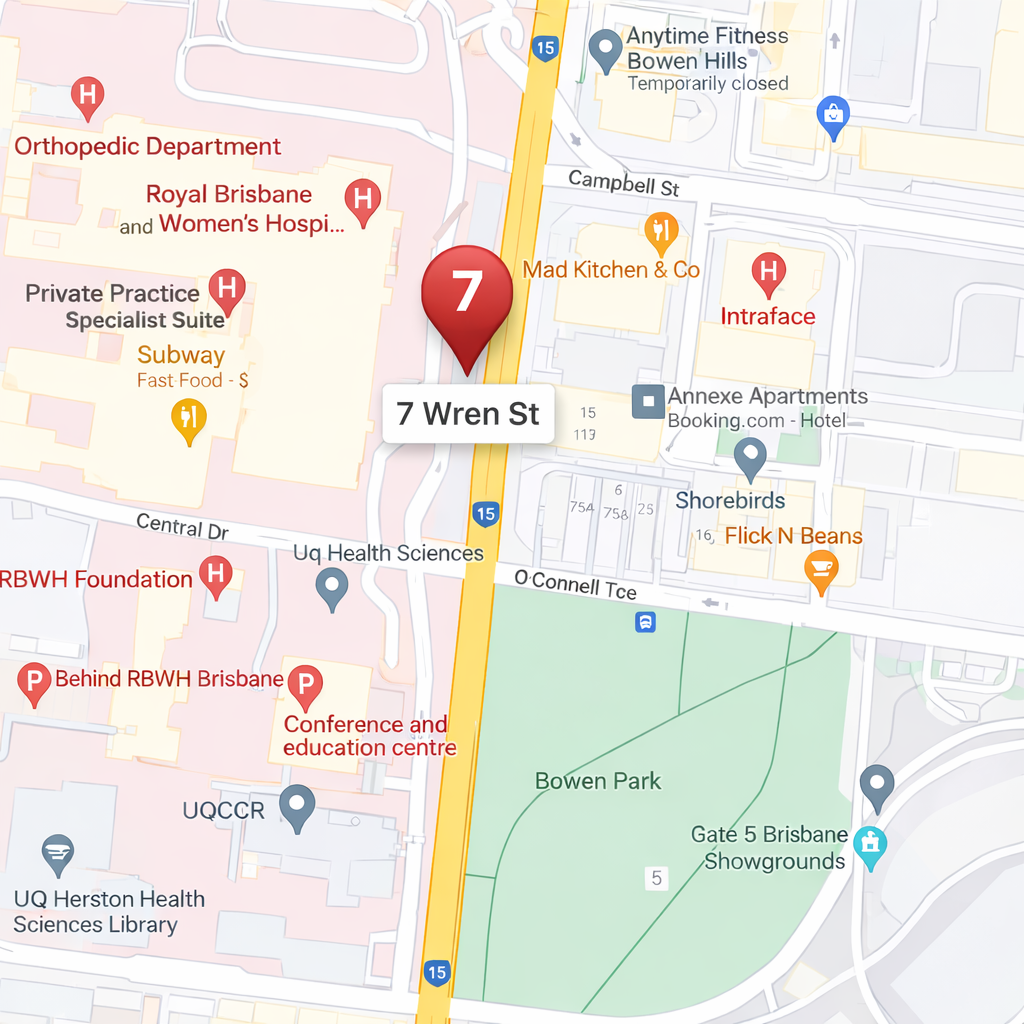
Location
Herston Private Hospital is located at 7 Wren Street, Bowen Hills.
Complaints
Herston Private Hospital values the thoughts, concerns and suggestions of consumers and all other partnering consumers. If you have any feedback about your experience, you can provide it by either:
- Requesting a Patient Experience Survey from the reception team
- Completing the feedback form online
- Emailing the team at reception@herstonprivatehospital.com.au
Complaints can be made to any of the following:
- Nursing Management
- Chief Operating Officer / Director of Nursing
- Medical Issues
- Your treating Surgeon
- Herston Private Hospital’s Medical Advisory Committee (MAC)
- Health Fund Issues
- Your private health fund
- The Private Health Insurance Ombudsman complaints hotline 1800 640 695
- www.ombudsman.gov.au